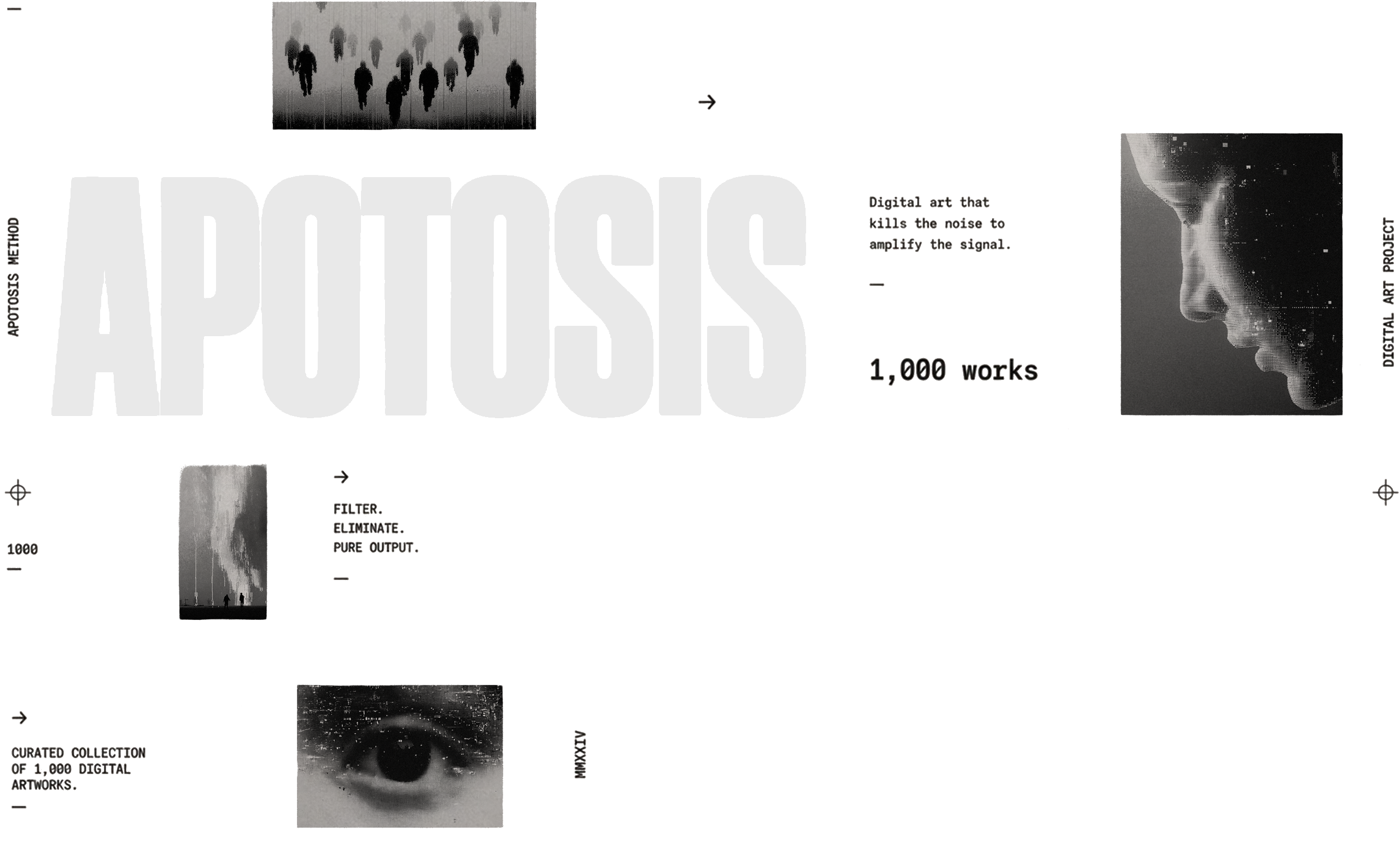
Apotosis
/ap-oh-TOH-sis/
noun
The programmed decay of data, noise, or excess information so that more valuable signal can survive.
Mint
Minting closed.
The 30-day primary sale window has ended.
01
02
03
04
05

What You Collect
Issued tokens came from a 1,000-work ERC-721 art collection. Every work is unique, but there are no rarity traits, hidden ranks, or rarity sniping mechanics.
Apotosis is meant to be collected visually: as digital art shaped by selection, scarcity, and the market mechanics surrounding its release.

Reveal
Minted artworks revealed individually after purchase. Works left unminted at the end of the primary sale are treated as unissued pieces and are no longer offered through this site.
Recent revealed works will populate the work grid as mint activity appears on-chain.

Provenance
The final artwork order is prepared before launch. A provenance hash can be published on-chain so the ordering can be checked after metadata is complete.
Metadata can be frozen after final confirmation, reducing the ability to change token artwork later.

Adaptive Pricing
During the primary sale, price rose when minting was ahead of the 30-day schedule and fell when minting was behind schedule. The minimum price was 0.005 ETH and the maximum price was 0.5 ETH.
Multi-item mints were priced sequentially, with each selected item quoted at its own position in the mint order.

Primary Split
Primary mint ETH split automatically during each successful mint: 10% to the artist wallet and 90% to the project reserve wallet.
The mint contract did not retain normal sale proceeds. The reserve allocation created the pool for the Digest process that follows the primary sale.

Reserve Digest
After minting, project reserve funds are intended to buy the current floor work from the collection and burn it, permanently removing that token from circulation.
Each digest makes the surviving set smaller and more selected, echoing biological apoptosis by clearing away floor works so the strongest signal remains.

Artist
About Rhett Mankind
Rhett Mankind is an award-winning digital artist with over 25 years in branding, digital art, and creative direction. He has taught digital and crypto art, and is the original creator of Turbo Token.
Following a life-altering health event, he turned to art as a way to explore meaning, finding purpose through creating and sharing.
Signal Log
The active reserve bid is variable as part of the digest process and is not a guaranteed buyback.
Adaptive Price History
Floor: 0.005 ETH / cap: 0.5 ETH
FAQ
Is there a whitelist or presale?
No whitelist or presale is planned. Apotosis is intended as a public sequential mint where collectors mint the next available work at the current adaptive price.
Is the primary mint still open?
No. Minting opened on the live contract at 22:00 UTC on Thursday June 11, 2026, and the 30-day primary sale window has now closed.
What was the mint price model?
The target price was 0.025 ETH when the sale was on pace. The adaptive price could move between 0.005 ETH and 0.5 ETH depending on whether minting was behind or ahead of the 30-day schedule.
Is there a team allocation?
The intended release is a public collection of 1,000 works with no reserved team allocation. Test mints may happen on testnet only while the system is being checked.
Is there a roadmap or future utility?
No roadmap, utility, access, yield, profit, or future benefit is promised. This is an art-first release and an experiment in presenting digital work through adaptive market mechanics.
Why this release strategy?
The release is designed to make the minting process transparent and visible. Price responds to pace, minted works reveal individually, and unsold works stay hidden until collected.
What am I actually collecting?
You are collecting one unique digital artwork from a 1,000-work ERC-721 collection. There are no rarity traits or hidden ranks; the work is meant to be judged visually and subjectively.
Where is the artwork stored?
Final metadata should point to the prepared artwork files through the project metadata setup. Minted tokens reveal their final metadata after purchase, and metadata can be frozen once the final configuration is confirmed.
What happens if the collection does not sell out?
Unminted works are treated as unissued pieces after the primary sale window. They are not owned or tradable NFTs unless they are minted on-chain, and they are no longer offered through this website.
How does the Reserve Digest decide what to buy?
The intended digest process uses the project reserve to acquire a current floor work from the collection and burn it. The exact execution depends on market availability, safe transaction handling, and published project communication.
Is the Reserve Digest guaranteed?
No. The digest is an intended project-reserve response, not an automatic mint-contract function and not a guaranteed floor support program.
Is this meant to support the floor price?
No floor price, resale value, or liquidity is promised. The digest is a conceptual scarcity and curation mechanism: it may remove works from circulation, but it should not be treated as financial assurance.
Will there be a community or Discord?
There is no promised community program or Discord requirement. Any official links will be shared through the project site or the artist's verified channels.
What rights do collectors have?
Collectors receive the NFT and can display or resell it in the usual collector context. Unless a separate license says otherwise, copyright and commercial rights remain with the artist.
Are there any guarantees or expectations?
No. There are no guarantees around price, liquidity, resale value, royalties, marketplace support, future drops, utility, or ongoing development. Collect because you want the work and want to support the experiment.